

Australia is strengthening its position as one of the Asia-Pacific region’s most important biotechnology and medical research centres. The country’s competitive advantage is not based on a single scientific discipline. It comes from the interaction between universities, teaching hospitals, biotechnology companies, government funding programs, clinical trial networks, and globally recognised research institutes.
This interconnected ecosystem allows Australian researchers to move discoveries from laboratories into diagnostic platforms, medical devices, vaccines, pharmaceuticals, and personalised treatments. However, the industry’s long-term success will depend on whether Australia can commercialise more of its locally developed intellectual property rather than allowing promising technologies to move overseas during the scale-up stage.
Public Research Funding Supports Long-Term Development
A major pillar of Australia’s biotechnology strategy is the Medical Research Future Fund, commonly known as the MRFF. The Australian Government established the fund to provide long-term support for health and medical research, with an intended capital base of A$20 billion.
The fund supports projects in areas such as rare diseases, genomics, antimicrobial resistance, clinical trials, preventive health, digital healthcare, and advanced therapeutics. Information about its programs and funding priorities is available through the Australian Department of Health and Aged Care:
Unlike conventional research grants that may concentrate mainly on scientific discovery, MRFF initiatives frequently emphasise translation. This means researchers are encouraged to demonstrate how an idea could improve clinical practice, reach patients, reduce pressure on the healthcare system, or become a commercially sustainable product.
Australia’s Biomedical Research Precincts
Several geographic clusters play a central role in the industry’s development.
Melbourne’s biomedical precinct brings together organisations such as the University of Melbourne, WEHI, the Peter MacCallum Cancer Centre, the Royal Melbourne Hospital, and biotechnology companies working in cancer, immunology, genomics, and infectious diseases.
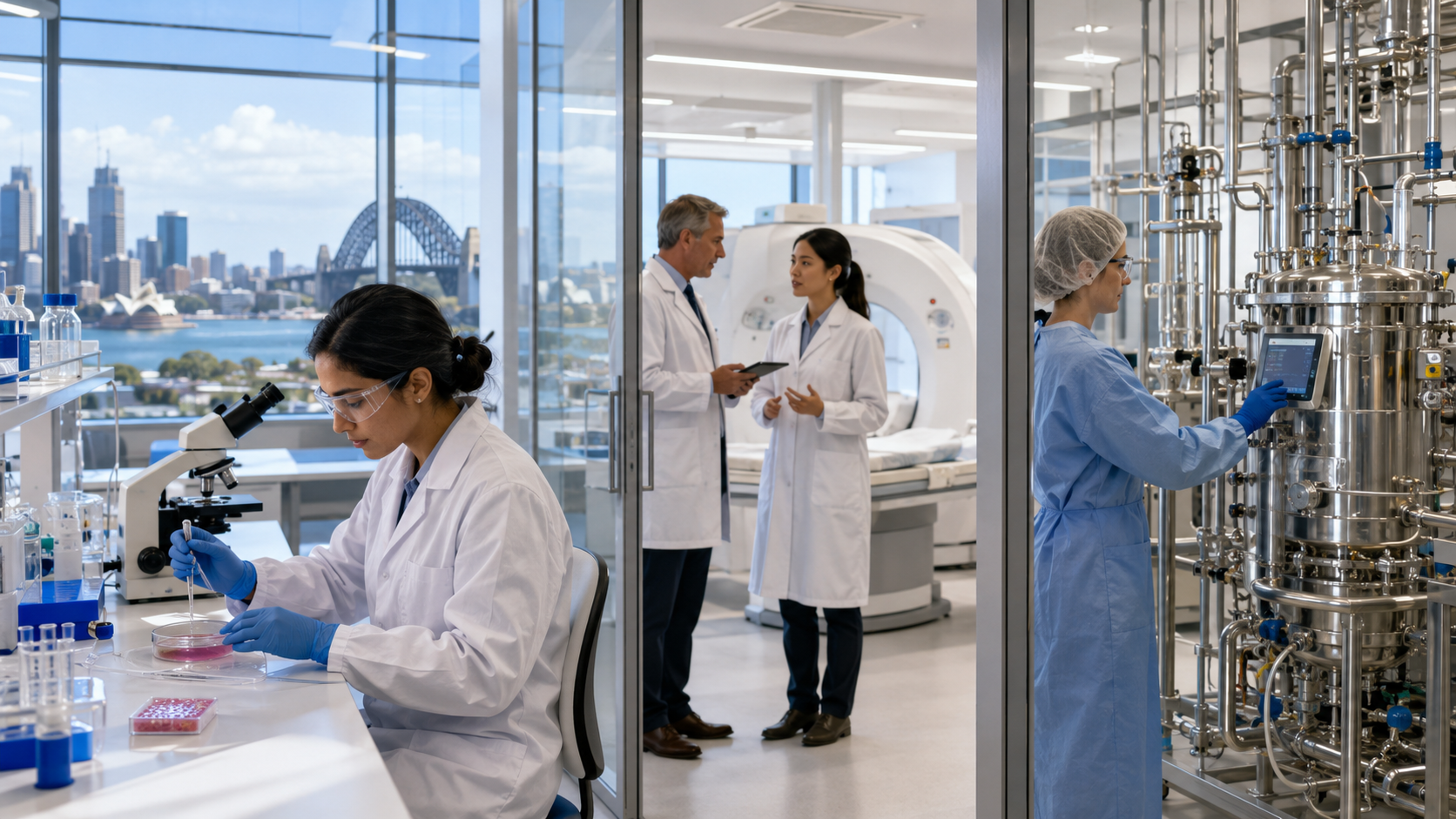
Sydney has developed strong capabilities in medical devices, cell and gene therapies, neuroscience, and digital health. Brisbane is also emerging as an important centre for vaccine delivery technology, diagnostics, tropical medicine, and biomanufacturing.
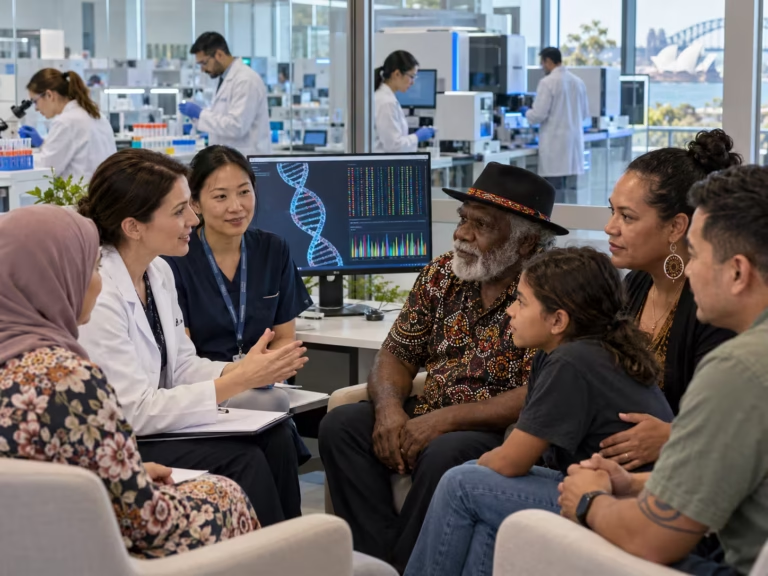
These clusters create opportunities for researchers to collaborate with clinicians and test innovations in real healthcare settings. They also provide access to specialised laboratories, skilled employees, research infrastructure, and investment networks.
The Commercialisation Challenge
Australia produces high-quality scientific research, but the transition from academic discovery to commercial product remains difficult. Early-stage biotechnology companies often need substantial capital before they generate revenue. Drug development may require many years of laboratory research, clinical testing, regulatory assessment, and manufacturing preparation.
Australian companies may therefore seek larger funding rounds in the United States or Europe. In some cases, local inventions are licensed or sold to overseas corporations because domestic scale-up capital is limited.
This creates an important policy question: should Australia focus primarily on producing scientific discoveries, or should it also build the manufacturing and investment capabilities required to retain more economic value domestically?
A Growing International Opportunity
Global demand for advanced diagnostics, precision medicine, vaccines, digital therapeutics, and treatments for ageing-related diseases is expanding. Australia is well positioned to participate because it has a respected regulatory system, experienced clinical researchers, internationally connected universities, and a diverse population suitable for clinical studies.
The next stage of growth will require stronger collaboration between scientists, entrepreneurs, investors, manufacturers, regulators, and healthcare providers. If those connections continue to improve, biotechnology could become not only a research strength but also a major source of Australian exports, high-skilled employment, and long-term health security.