

When K-Pop Feels Local: The Power of Australian Idols
One of the most distinctive features of K-Pop’s Australian success story is the presence of homegrown talent at its highest levels. Unlike markets where K-Pop remains a purely imported cultural product, Australia enjoys a unique advantage: some of the genre’s biggest stars are, in a very real sense, Australian.
Stray Kids: Two Australians at K-Pop’s Forefront
Bang Chan and Felix of Stray Kids represent perhaps the most visible Australian presence in global K-Pop. Their impact on the Australian market is both cultural and commercial—Stray Kids’ EP This & That reached number three on the ARIA Albums Chart in August 2026, marking the group’s ninth top-20 appearance in Australia.
Their Australian identity matters. When Australian fans see Bang Chan and Felix performing at the highest level of K-Pop, the genre ceases to feel foreign. It becomes, instead, a legitimate pathway for Australian talent. This is particularly significant for young Australians of Asian descent who see themselves reflected in these performers.
Beyond Stray Kids: A Broader Pattern
The Australian K-Pop diaspora extends well beyond Stray Kids. Rosé of BLACKPINK grew up in Australia and has become one of the genre’s most recognisable voices globally. Jake of ENHYPEN holds Korean-Australian dual citizenship. Danielle and Hanni of NewJeans both boast Australian roots.
This pattern creates what industry observers describe as a “local ownership” of K-Pop that differs from most Western markets. Australian fans are not merely consuming Korean culture—they are participating in it through performers who share their cultural background, accent, and sensibilities.
AussieBroSquad: Performing Australian Identity Through K-Pop
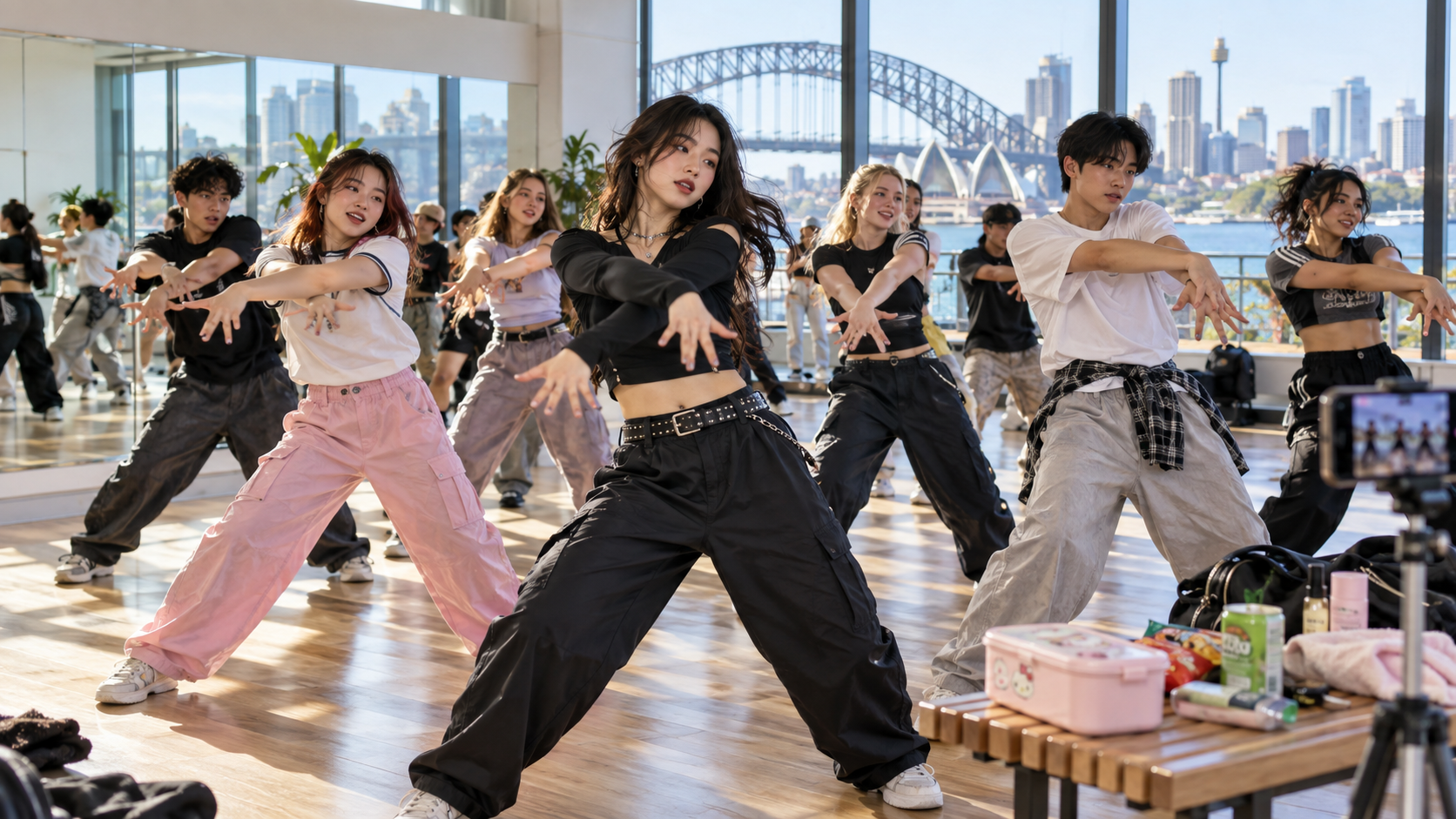
Beyond individual idols, Australia has produced performance groups that interpret K-Pop through a distinctly Australian lens. AussieBroSquad, an Australian performance group that visited Seoul in July 2026, has built a following by combining K-Pop’s high-performance standards with Australian cultural values of freedom and friendliness.
The group’s approach—”not simply imitating existing K-Pop idols, but combining Australia’s free and friendly culture with K-Pop’s high performance completeness, thorough self-management, and global vision”—represents a fascinating cultural hybridisation. They are not performing Korean culture; they are performing Australian engagement with Korean culture, and that distinction resonates with local audiences.
Cultural Identity and the Next Generation
The presence of Australian idols has measurable effects on how young Australians relate to K-Pop. For thirteen-year-old Brisbane student Vivi Pham Dac, K-Pop idols are simply “so talented”—the Australian connection makes their achievements feel attainable rather than aspirational.
This dynamic also influences the broader Asian-Australian cultural landscape. As one Korean cultural analysis noted, Australia’s multicultural social structure serves as a core foundation for K-Pop demand expansion—K-Pop is consumed not as “foreign culture” but as a cultural phenomenon connected to local identity. The result is a feedback loop: Australian idols attract Australian fans, who then support the broader K-Pop ecosystem, which in turn creates more opportunities for Australian talent.