


The Australian professional has always fought a war with the weather. However, the climate crisis has escalated this conflict, forcing a fundamental rethink of what constitutes appropriate office attire. The era of “suffering for fashion”—sweating through a polyester suit during a 40-degree Sydney heatwave—is increasingly viewed as both archaic and impractical. In 2026, the driving force behind Australian corporate style is not just aesthetics, but climate resilience and thermal regulation.
The Science of Staying Cool
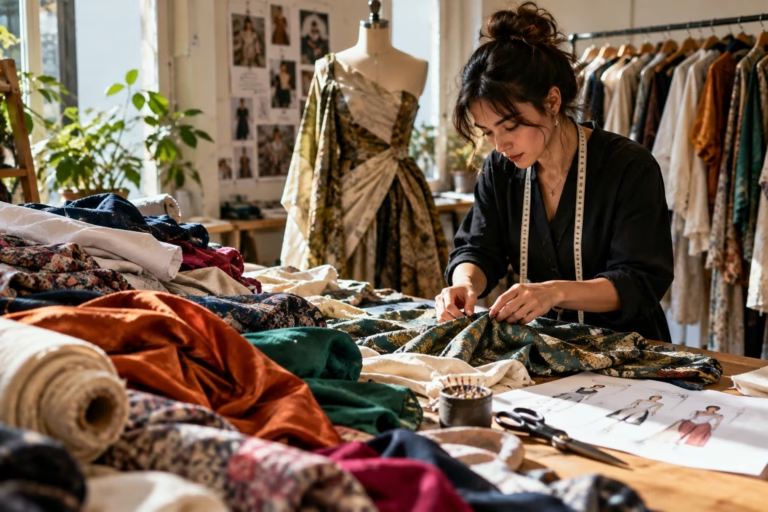
The modern Australian summer wardrobe has pivoted decisively towards natural fibers, but with a technical twist. Linen, once the crinkly uniform of the tourist, has been re-engineered. We are now seeing “performance linen” that has been woven with high-twist yarns to resist creasing while maximizing airflow. Similarly, tropical wool, which weighs significantly less than standard suiting wool, has become a staple for bankers and barristers who must maintain a formal appearance without overheating.
The integration of UV protection into professional fabrics is another significant leap. Shirts and blouses rated UPF 50+ are no longer limited to the sportswear section. They are being tailored into crisp, white business shirts and elegant blouses, allowing professionals to walk to their meetings without accruing sun damage. This blend of health consciousness and style is a distinctly Australian innovation.
The “Cool Biz” Revolution
Japan pioneered the “Cool Biz” campaign decades ago, encouraging workers to ditch ties to save energy on air conditioning. Australia has adopted a more localized version of this. Government departments and private firms are increasingly issuing “heatwave dress code” exemptions. During periods of extreme heat, employees are permitted—even encouraged—to wear tailored shorts, open-collar shirts, and breathable footwear.
This isn’t about lowering standards; it is about optimizing productivity. The data is clear that cognitive function declines in uncomfortable thermal environments. Employers are realizing that a melting employee is an ineffective employee. The 2026 “Workplace Health Index” by Safe Work Australia notes a direct correlation between flexible heat-related dress codes and reduced incidents of heat stress in the white-collar sector (Source: Safe Work Australia – Working in Heat Report 2026).
Redefining Formality
The ultimate result of this climate adaptation is a new visual hierarchy of formality. The tie is almost extinct in most sectors, viewed as a heat trap. Heavy brogues are replaced with high-quality leather loafers or woven shoes. The emphasis has shifted from “coverage” to “quality of fabric.” An executive in a loose-fitting, $800 silk-linen blend shirt is now perceived as more “professional” and powerful than one sweating through a $100 tight polyester shirt.
This pragmatic approach to dressing is breaking down stodgy old rules, allowing Australian professionals to present themselves with a sense of ease and authority that is uniquely suited to the environment they inhabit. It signals a confidence that doesn’t require a restrictive uniform.